
I’m Eiji Sekiya, a software architect at TIER IV, and in this blog post, I’ll talk about the cloud system we’re crafting and outline our approach to development. Whether you’re a cloud engineer unfamiliar with the world of autonomous driving or just someone curious about the technology, this article is tailored to pique your interest in TIER IV and provide insight into the work we’re doing.
Level 4: New era in autonomous driving
California approved the operation of autonomous taxi services in San Francisco on Aug 10, 2023. Meanwhile, in Japan, autonomous driving is trailing in both technological advancement and societal acceptance.
To address this disparity, the government is championing RoAD to the L4 — an initiative aimed at establishing advanced mobility services, including Level 4 autonomous driving. At Level 4, all driving operations within predefined conditions and environments are performed by the AD system. As an active participant in the project, TIER IV is conducting technical demonstrations, collaborating with government agencies, and working toward the rollout of Level 4 services in Japan.
Many steps must be cleared to transform autonomous driving into a viable service. From vehicle design, software development, map creation and simulation-based evaluations, to the deployment of software and map data, field testing and demonstrations on public roads. Experts are working together to analyze and address issues that may arise at each stage.
Web.Auto: A one-stop shop for AD services
Data analysis, machine learning pipelines, large-scale simulations, map management, fleet management, software updates, vehicle dispatch and remote support are among the many services required to operate autonomous vehicles, and TIER IV has consolidated these services into a single product called Web.Auto.
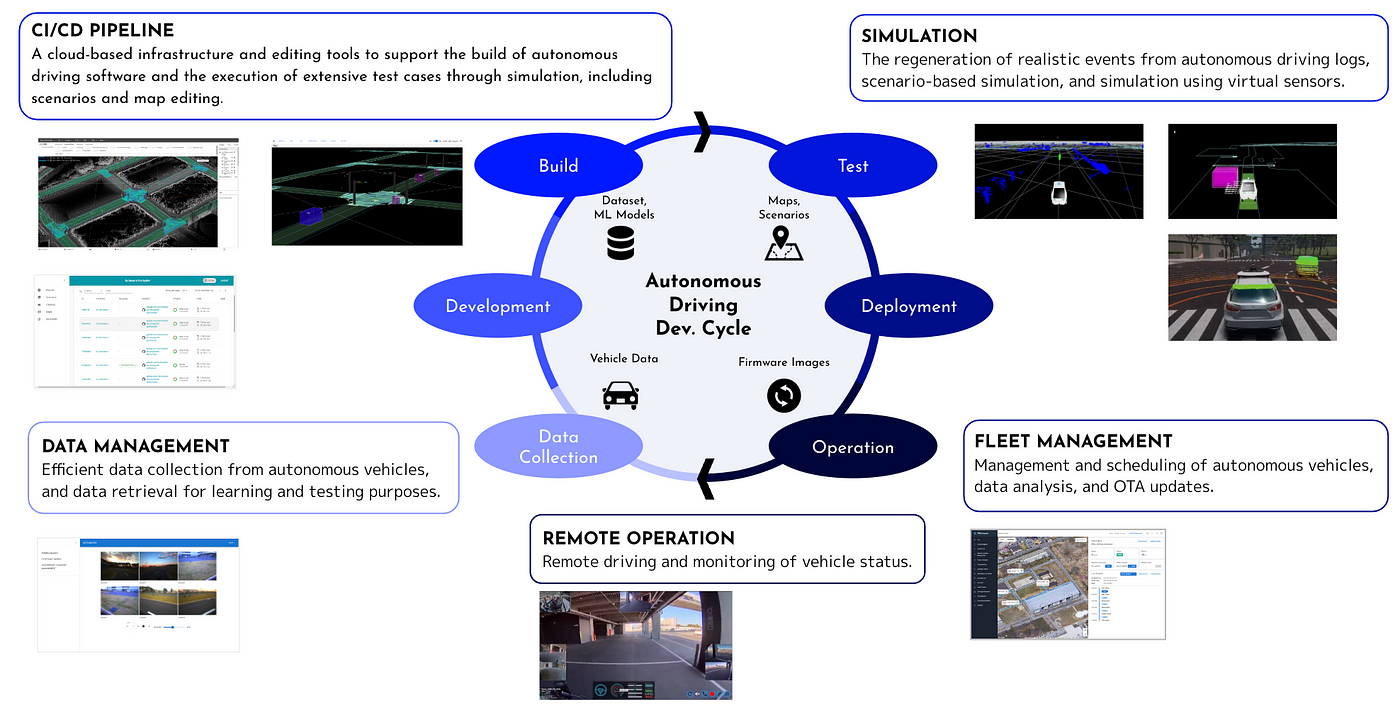
Web.Auto overview
- Data management
- Collection of driving data, including driving history and statistics; management and detection of unstructured data including sensor data
- Machine learning
- Management of annotation data; execution of training; version management of machine learning models
- Map management
- Provision of map editing tools; version management of map data
- CI/CD
- Provision of test scenario editing tools; execution of large number of simulations; generation and management of vehicle distribution firmware
- Operation management
- Vehicle management; dispatch control; AD status monitoring
- Remote support
- Delivery of camera footage from inside and outside the autonomous vehicle; call functions
- Authentication and authorization
- Role-based access control to manage service user privileges; OAuth 2.0-based authentication mechanism
Cloud development: Teams and approach
Currently, six teams are involved in the development of the above cloud services. Only a few team members have backgrounds in the automotive industry.
Development style
Each team creates a mid-term roadmap once a year based on the business strategy and R&D direction, reviewing plans and priorities daily during the period. Development occurs in 2-week sprints.
Technology stack, tools
We utilize AWS for our cloud services. All teams are building scalable infrastructure using serverless technologies such as EKS, Fargate, Lambda and DynamoDB. On the back end, we mainly use Go and Python. On the front end, we use React, Typescript, and WebGL technologies.
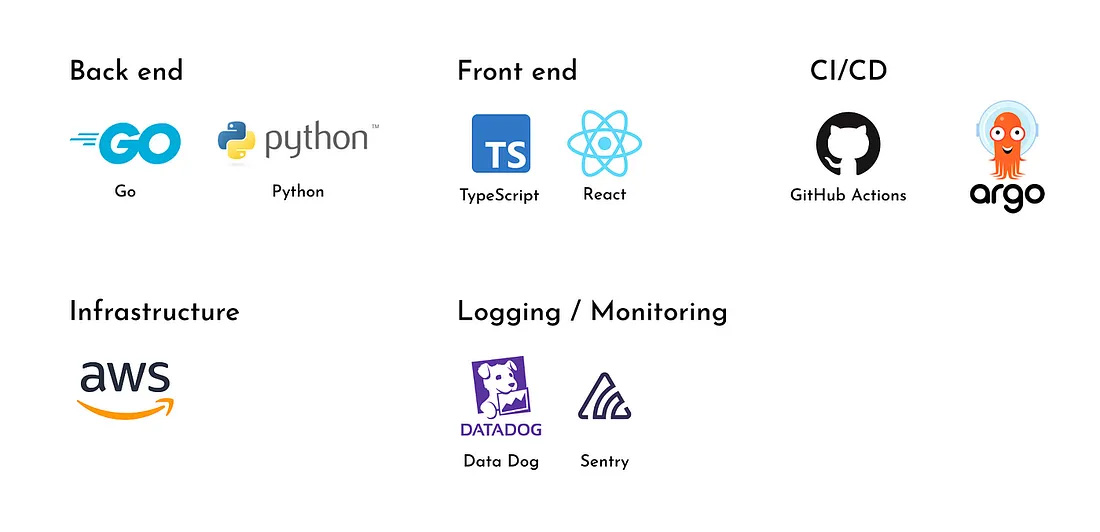
Technology stack
We also use the following tools for day-to-day operations:
- Figma: UI/UX study of the application
- Datadog: Log collection and analysis, and SLI monitoring
- Sentry: Application defect collection
- Opsgenie: Incident management and on-call
- SonarCloud: Code analysis
Introducing the teams
FMS/Maps
The FMS/Maps team is responsible for the development of the operation and map management services. For the operation management service, we use AWS IoT to build a system that connects to vehicles and Amazon Neptune, a graph database, for route planning. For map management services, we’re building a rich editing tool using WebGL and a map generation pipeline from driving data.
Drive
The Drive team is developing a system to monitor the operation of autonomous vehicles remotely using video and audio — a critical function for Level 4 operations.
We’re using WebRTC to build an ultra-low latency media delivery system, enabling seamless video and audio streaming, prioritizing operational features to enhance and maintain communication environments. This includes objectively evaluating delivery quality and ensuring compatibility with advanced 5G and local 5G technologies. We’re also developing assistive technologies for autonomous driving, such as facilitating voice communication with passengers and providing remote control assistance.
CI/CD
The CI/CD team manages test scenarios and develops services to run simulations.
To run large numbers of simulations, we’ve engineered a configuration that rapidly and extensively scales using AWS Step Functions, Karpenter, DynamoDB Streams, and other tools for the provision/deprovision lifecycle. We’re also analyzing how results may vary based on factors such as instance selection and container configurations to prevent simulation evaluations from becoming unreliable.
Data/ML
The Data/ML team collects driving data and develops training services for machine learning.
It gathers data from driving histories and various services, providing data through APIs and analysis tools. In comparison to other teams, it extensively uses Amazon Data Streams, Kinesis Data Firehose, AWS Glue, AWS Data Migration Service, and also makes use of tools like Amazon Athena. The Data/ML team not only provides an analysis platform for internal users, but also offers APIs as a service for partners, unlike most data infrastructure teams.
Cloud
The Cloud team provides authentication and authorization services, and works to improve the reliability of each service through site reliability engineering (SRE).
The authentication service is provided using Ory’s OSS, and an in-house role-based access control authorization service is provided for each service. SRE is aimed at improving the reliability of each service through the establishment of mechanisms that aid in monitoring and operations. As a result of these efforts, Web.Auto successfully passed AWS’s Foundational Technical Review.
QA/QC
The QA/QC team designs tests and champions automated testing to enhance the quality of each team’s service.
The team conducts autonomous testing in Cypress and measures quality metrics in SonarCloud. QA/QC also works with the evaluation team for AD systems to examine end-to-end testing mechanisms.
Collaboration is key
Developing domain-specific services for autonomous driving is a complex task that extends beyond the capabilities of the teams mentioned above. Collaboration is essential, and, as such, we work closely with other teams at TIER IV and various partners. The diverse array of specialists at our disposal is instrumental in propelling the company forward, fostering continuous learning throughout the journey.
Future challenges
Our development efforts are currently focused on four key pillars:
Realizing Level 4 services
As we gear up to introduce Level 4 autonomous driving, there are a few crucial services that are still in development, and we’re working diligently to make them a reality.
So far, we’ve achieved functionalities like vehicle monitoring and dispatch. Looking ahead, it’s essential to establish a mechanism that allows remote instructions in case of an AD stack failure in unmanned scenarios. We need the capability to achieve similar functionalities on a larger scale as we expand operational areas.
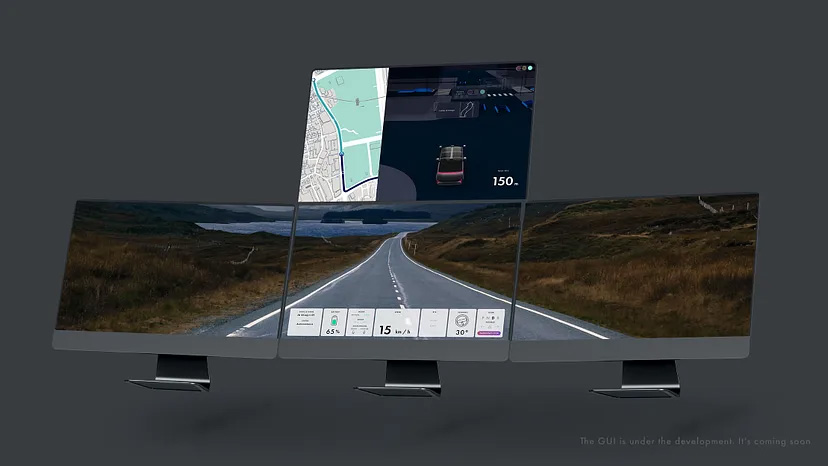
Prototype graphic user interface for remote monitoring service
Streamlining development, operation cycle
Developing and operating autonomous driving services require specialized skills and involve time-consuming processes. The efficiency of procedures must be improved to further increase reliability and availability, and expand into new operational areas.
We aim to automate and simplify various tasks, including:
- Vehicle sensor calibration
- Map creation and evaluation
- Fine-tuning and domain adaptation of machine learning models
- Analysis of system malfunctions
- Exploration of edge cases
- Addition and management of evaluation criteria
The goal is to enhance efficiency by minimizing manual intervention, eliminating subjectivity, and streamlining processes. To achieve this, we’re collaborating with specialized teams to develop cloud services while catching up on mapping technologies (such as simultaneous localization and mapping) and machine learning domain adaptation techniques (such as pseudo labeling and ground truth sampling). We also aim to leverage generative AI technology in the management of evaluation scenarios.
Improving service reliability
The evolution of autonomous driving into a transportation infrastructure underscores the critical importance of safety and reliability. We participate in AD initiatives with a profound understanding of their significance.
For example, we’re working with the AD system development team and the simulation team to analyze flaky evaluations and strengthen monitoring of driving performance. In the context of cloud development, we’re also considering continuous monitoring of service level indicators and raising service level objectives for future unmanned services.
Scaling operations
Realizing AD services is challenging for a single company to accomplish alone. Collaboration with various partners is essential for global business expansion.
For this reason, we’re building on the assumption that APIs will be made available for all services, and we’re also creating software development kits and command-line interfaces. Simplifying API usage is something we’ll be working on in the future. We’ll also be expanding cloud services regionally in preparation for global expansion.
Wrap-up
The development of autonomous driving technology involves various challenges. Reliability will have to be improved for it to become an integral part of infrastructure in society.
Our company is fortunate to have specialists in various fields, providing ample opportunities for learning and growth. If you’re interested in taking on technical challenges, learning new things, doing work that impacts society and being involved in global business expansion, we’d love to hear from you.
Eiji Sekiya
Architect | Architecture Team
An alumnus of Osaka University’s Graduate School of Engineering, Eiji joined TIER IV in March 2018. With previous experience developing data platforms and applying machine learning in business contexts, Eiji currently leads cloud development. He has also worked on AD operation management systems and evaluation platforms.
Join Our Open-Source Journey
TIER IV is always on the lookout for passionate individuals to join our journey. If you share our vision of making autonomous driving accessible to all, get in touch.
Visit our careers page to view all job openings
If you’re uncertain about which roles align best with your experience, or if the current job openings don’t quite match your preferences, register your interest here. We’ll get in touch if a role that matches your experience becomes available, and schedule an informal interview.
Media contact
pr@tier4.jp
Business inquiries
sales@tier4.jp
Social Media
X (Japan/Global) |LinkedIn| Facebook | Instagram| YouTube
More