
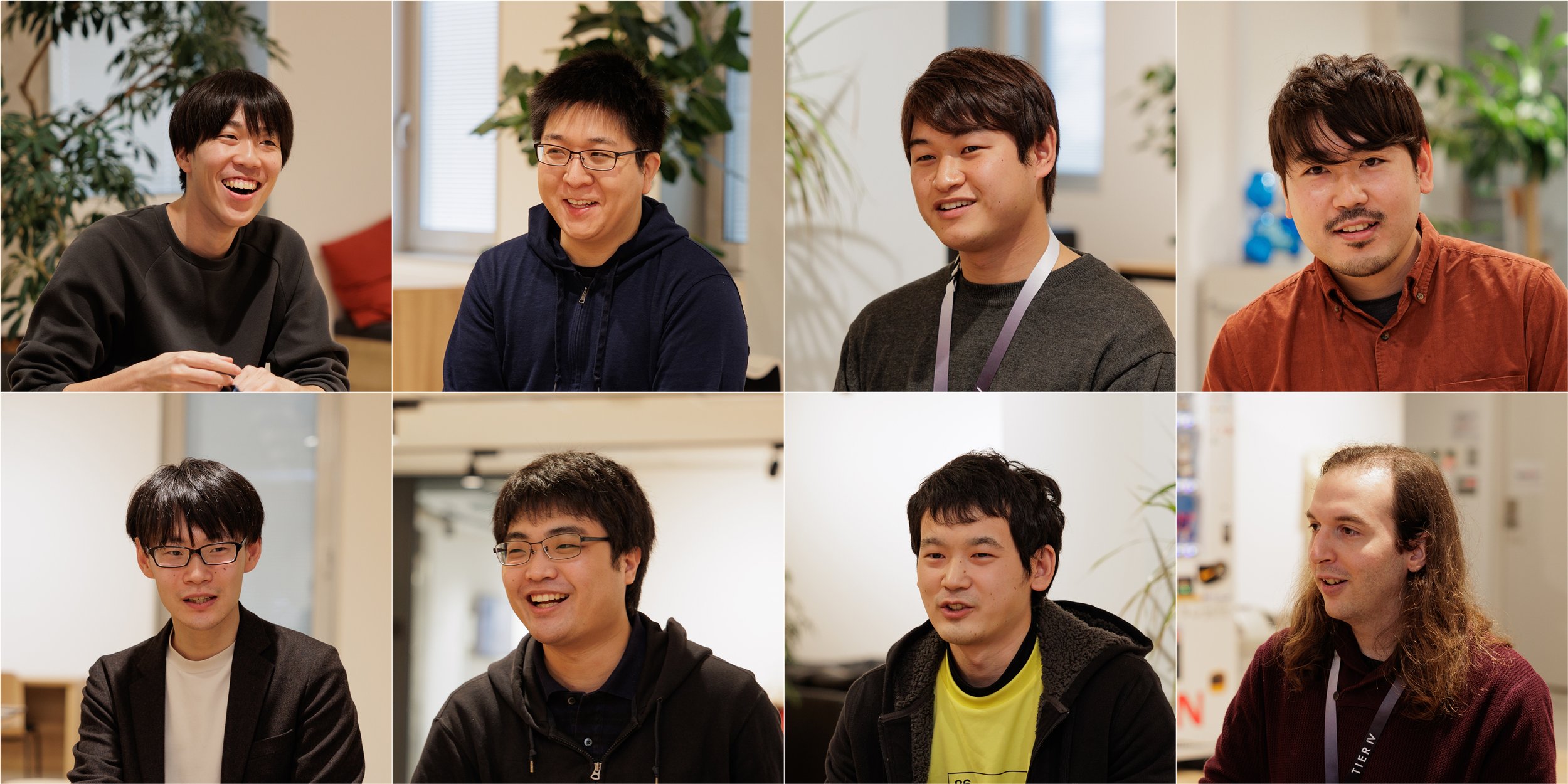
 Clockwise from top left: Gakuki Ise, Kenji Miyake, Takeshi Miura, Satoshi Ota, Maxime Clement, Kento Yabuuchi, Ryohsuke Mitsudome and Yoshi Ri.
TIER IV PEOPLE shines a light on the people and teams whose unique experiences, backgrounds, and stories bring our mission to life. For this three-part series, we brought together Autoware engineers to talk about the open-source autonomous driving software at the core of TIER IV.
The discussion features team members who have been with the company from its early days, as well as those who joined more recently. This installment focuses on Autoware's growth and the team members' thoughts on TIER IV before joining and how those views evolved after they arrived.
Members
Ryohsuke Mitsudome
Ryohsuke joined TIER IV in October 2018, where he initially contributed to the development of Autoware's map and planning modules. As a software architect, he is currently focusing on the interface design of Autoware, while also serving as the chair of the Autoware Foundation’s Technical Steering Committee.
Maxime Clement
Maxime joined TIER IV in February 2021, bringing experience from his previous role at a robotics startup, where he was involved in the development of autonomous driving software. As a research engineer on TIER IV’s Planning/Control team, he is focusing on new feature development for Autoware through the open-source community, as well as improving planning behavior in response to dynamic obstacles.
Satoshi Ota
Satoshi joined TIER IV in April 2021 straight out of university. During his studies in aerospace engineering, he researched drone planning and gained experience developing tunnel inspection drones at a startup. Since joining TIER IV, he has worked on integrating Autoware into autonomous shuttles and is currently developing Autoware’s Planning module.
Kento Yabuuchi
Kento was a member of TIER IV founder Shinpei Kato’s research lab at graduate school, where he focused on self-location estimation research. At the same time, he worked part-time as an engineer at TIER IV affiliate MAP IV. Before graduate school, he participated in the NHK Robot Contest for several years. He joined TIER IV in April 2022 after completing his graduate studies. He wears yellow clothing every day.
Yoshi Ri
Yoshi joined TIER IV in August 2022 and currently works on improvements to vehicle and pedestrian detection and tracking functions. Before joining TIER IV, he spent two years developing autonomous drones at a heavy industry manufacturer.
Takeshi Miura
Takeshi joined TIER IV in April 2021, following a one-year stint at a major automotive manufacturer developing autonomous driving systems. Since then, he has been responsible for integrating Autoware into systems such as autonomous transport for factories and low-speed shuttles, as well as developing route planning features. He is currently responsible for integrating Autoware into passenger cars.
Kenji Miyake
Kenji joined TIER IV in August 2019, bringing five years of experience in autonomous driving research and development at an automotive parts manufacturer. Since joining TIER IV, he has been responsible for integrating Autoware into autonomous transport systems for factories and improving software quality. A software architect by trade, he is currently focused on optimizing development processes and streamlining operations within the open-source community.
Gakuki Ise
Gakuki joined TIER IV in July 2019, serving as project manager for domestic and international development and demonstration projects. He is currently based in the CTO Office, where he focuses on human resources and organizational development within the engineering team. Gakuki moderated this roundtable discussion.
From our Autoware to everyone’s Autoware
Gakuki: First, let’s take a look back at Autoware’s journey so far. We’ll go in order of when each of you joined. Share your thoughts on what Autoware and TIER IV were like at the time, as well as the work you were involved in. Among the team members here, Ryohsuke has been with the company the longest, right?
Ryohsuke: I joined in October 2018, when our office was located at Entrepreneur Plaza at the University of Tokyo. The team consisted of about 20 engineers, and the atmosphere was more like a university research lab. We were developing software based on Autoware.AI, which was created at Nagoya University, adding new features and testing them through proof-of-concept experiments. It felt like we kept adding ingredients to it, to the point that we jokingly called it our “secret sauce.”
At the time, only TIER IV really knew how to use Autoware, but the establishment of the Autoware Foundation (AWF) marked a major shift – it was no longer just TIER IV’s project. This was a big step forward for Autoware as an open-source platform. [The AWF is the world’s first international industry organization aiming to establish a standard for autonomous driving operating systems.] It also brought about a change internally, creating an atmosphere where people started to take things more seriously.
Gakuki: Kenji, you joined about a year after Ryohsuke, around the time the atmosphere at the company started to change. How did you come across TIER IV?
Kenji: I was working on autonomous driving in my previous role and was aware that Autoware had been released as open-source software (OSS) by Nagoya University, even experimenting with some of the sample code. While I didn’t have a particularly strong interest at the time, my interest was piqued when the Autoware Foundation was established – TIER IV's visibility grew because of things like tech blogs and events like ROSCon JP. That's when I thought this seemed like an interesting group of people, and decided to apply. By the time I went through the hiring process and received an offer, the company had secured significant funding, which gave me the impression that things were really taking off.
When I first joined, I was working on Autoware.AI. Not long after, there was a push to rethink the architecture to accommodate various use cases, such as autonomous taxis and cargo transport for factories. I worked with Ryohsuke and others to build a prototype over about three months, equipping it with all the essential functionalities, and then we conducted demos. After that, we worked on expanding the prototype, improving and stabilizing its features through proof-of-concept tests at various sites.
Gakuki: The re-architecture project was developed intensively by a small, dedicated team if I recall.
Ryohsuke: You’re talking about Minamisoma, right? It was in the middle of nowhere, with just the testing grounds. We’d dive into experiments all day, then head to the hot springs together afterward. I still remember how much it felt like a club training camp from our student days.
Gakuki: Then in 2021, Maxime, Takeshi, and Satoshi joined the company. That was around the time the office moved from Hongo to Shinagawa. There was a shift toward telecommuting at the time. What was that experience like for you all?
Maxime: I was originally working in the autonomous driving division of another robotics startup. I knew about TIER IV as a competitor, but my interest grew when a colleague made the switch. I joined TIER IV in a research role at first, but now I’m in charge of OSS activities and development for external projects. I joined right in the middle of the COVID-19 pandemic. I worked closely with Ryohsuke, but we never met face-to-face, which felt a bit strange. Even so, I think I was able to get off to a smooth start.
Gakuki: Given your academic background, did TIER IV feel more like a university or a company when you first joined?
Maxime: A company, for sure. But in my case, it depends on the work. When it involves open-source software, there are collaborations with research institutions, and for certain projects, the atmosphere feels more academic. On the other hand, internal work is more project-driven with clients, so it has more of a corporate feel. Satoshi I joined the company straight out of university. When a high-spec laptop suddenly arrived at my doorstep, my first impression was, “Wow, this company really means business!” The lack of a structured training program at the time made it feel different to large companies. I had no experience with Autoware and the documentation was still a work in progress, so I struggled with some things. But with the generous support of my manager and team members, I was able to get a grip on things fairly quickly.
Takeshi: I worked at an automaker for about a year before joining TIER IV. A PC was delivered to my house, and after about a week of basic training, I was able to start working right away. My manager helped me set up my remote work environment, and we communicated almost every day for about two weeks. This close communication helped me settle into the job smoothly. I was really grateful for the support.
Gakuki: Takeshi, you were also involved in autonomous driving in your previous role at an automaker, right?
Takeshi: I was in charge of developing an automatic parking function. The software we used there was quite specialized, and it felt like only those who were familiar with it could really understand it. However, when I joined TIER IV, I noticed that a lot of effort had gone into making Autoware more accessible and understandable for a wider audience, thanks to it being open-source software.
Gakuki: A significant evolution from the 'secret sauce' days. Now, let's hear from those who joined in 2022. Kento, you came on board during a year of major changes for TIER IV, with increased funding on the table. I heard you worked here part-time before transitioning to a full-time role.
Kento: During my master's degree, I worked at Map IV, a group company that develops 3D maps for autonomous driving.
Gakuki: Did your view of Autoware and TIER IV change when you transitioned from part-time to full-time?
Kento: Before joining, I had never used Autoware. I’d only seen demonstration videos on YouTube and Twitter, so I thought, "Wow, this is possible." But I also thought it was just a demo and they were probably only showing the good parts. When I first worked with Autoware’s code, I was amazed to see it detect objects and avoid obstacles. I realized that it really works! It was impressive to see a car powered by Autoware actually driving through the streets of Nishi-Shinjuku.
Gakuki: Seeing it and actually working with it yourself is definitely different. Yoshi, you joined in August 2022. What was your impression of TIER IV before you joined?
Yoshi: I knew about TIER IV when I was a graduate student. I had a general idea of what Autoware was about, but what really stuck with me was the fact that the company was developing autonomous driving technology by offering proper salaries to undergrads. After joining, I was impressed by how well-documented things were, both internally and externally. The development environment was relatively simple to set up with the documentation. Even if there were things I didn’t understand, there were resources on the internal Confluence pages, so I could usually solve most problems with a bit of research. That was really helpful.
Gakuki: Let’s take a look at where Autoware stands today. Ryohsuke, how do you see things now compared to four years ago?
Ryohsuke: I think Autoware has become something that is easier to use on a broader scale. We get various questions and feedback, and not only from AWF members. There are still challenges, but there’s no doubt that we are making progress.
Kenji: The platform is constantly evolving and maturing. While individual features may seem to be developing slowly, the software structure and community management have improved, and we’re now ready to scale development through the power of open source.
Ryohsuke: TIER IV's common platform for CI/CD has also been improving. Efforts are underway to prepare scenarios that reduce the burden on each product team and to make the platform available as open source.
Gakuki: I get the impression that the development foundations have solidified. Let’s hear from the users. Satoshi, Takeshi, and Yoshi are using the current version of Autoware to develop autonomous driving systems. What aspects of it do you find easy to use, and where would you like to see improvements?
Takeshi: What makes it easy to use is the ability to select or discard functions based on the hardware configuration and performance. For example, the different path planning modules are divided into those that operate based on object recognition from perception and those that work solely with point cloud data. On the other hand, there are areas for improvement. The current object-based path planning function relies on GPU-based object recognition, so on computers without a GPU, some features may not be available. I think we need to make improvements in the future to support a variety of hardware configurations.
Satoshi: I’ve worked on system integration for autonomous buses. One of the strengths of Autoware is the ability to select and use the necessary features based on requirements. Many of the features are designed to minimize dependencies, so there are few constraints that enforce the use of certain features to enable others. This flexibility was very helpful in equipping vehicles with the necessary features for integration. However, because of this focus on modularity, there are use cases that can't be achieved with the current setup. I believe there is room for evolution in this area.
Yoshi: The Sensing/Perception module supports both deep methods using GPUs and non-deep methods, allowing for object tracking using various inputs. While I think the estimation accuracy is reasonably good at this point, there are cases where some features heavily depend on the accuracy of others or where features combine in a suboptimal way. In addition to improving individual features, I think there's room to adjust the overall structure itself to align with recent trends – such as feeding multiple sensor inputs into one large model and processing them all at once.
The discussion continues in part two of this roundtable, where the conversation shifts to the appeal of open-source software.
TIER IV is always on the lookout for passionate individuals to join our journey. If you share our vision of making autonomous driving accessible to all, get in touch.
Visit our careers page to view all job openings.
If you’re uncertain about which roles align best with your experience, or if the current job openings don’t quite match your preferences, register your interest here. We’ll get in touch if a role that matches your experience becomes available, and schedule an informal interview.
Media contact
pr@tier4.jp
Business inquiries
sales@tier4.jp
Social Media
X (Japan/Global) | LinkedIn | Facebook | Instagram | YouTube
More