
The previous installment of this series explored Autoware's simulation tools and emphasized the importance of both real-world tests and virtual simulations in validating autonomous driving systems. This installment looks into why ensuring safety in autonomous vehicles presents greater challenges compared to conventional automobiles.
The accompanying screenshot depicts a road scene during an autonomous vehicle test on public roads in Japan. The autonomous vehicle, bottom center, is at an intersection, waiting for the oncoming vehicles to pass.
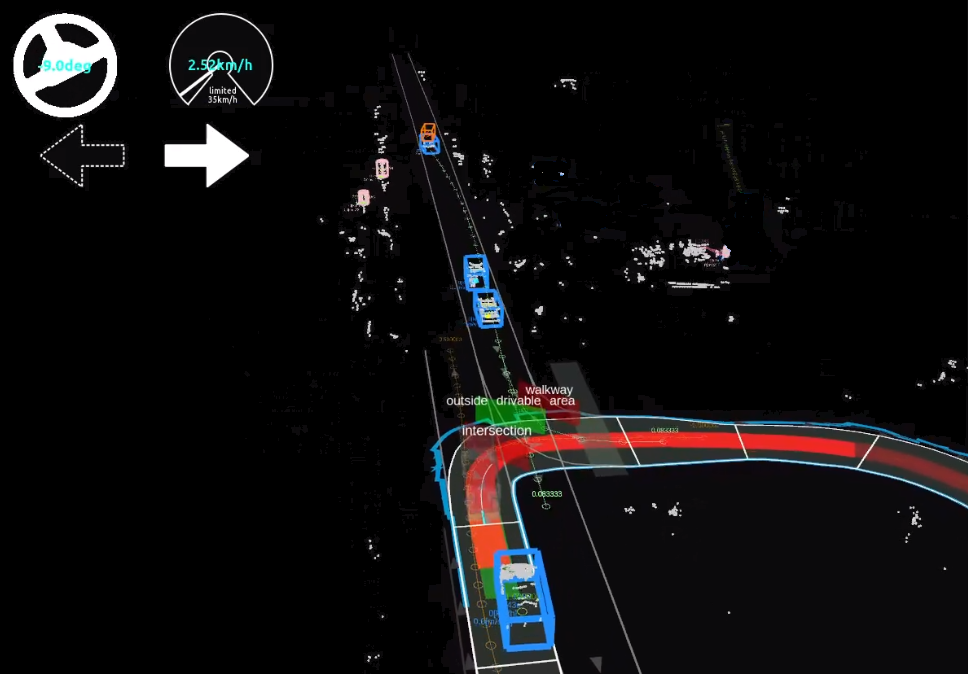 The illustration depicts an autonomous vehicle, bottom center, preparing to make a right turn.
In this case, the leading vehicle in the opposite lane slowed down to yield, which usually indicates that it's safe for the autonomous vehicle to turn once the oncoming car has sufficiently reduced its speed. However, a vehicle two cars behind the leading one was approaching rapidly from a distance. The autonomous vehicle judged that this fast-moving car might enter the intersection and decided to wait longer.
As a result, a standoff occurred in the middle of the intersection, with neither vehicle moving forward. A human driver would likely proceed, assuming that the rapidly approaching vehicle would not overtake the leading car, but for Autoware, such a judgment was not expected.
To address this case, it’s important to consider several factors: the possibility of multiple lanes of oncoming traffic, or that the following vehicle might be a motorcycle, and the risk of committing a traffic violation by turning right into the intersection even if the oncoming vehicles yield. All these scenarios need to be thoroughly re-evaluated before the software is updated and retested.
When autonomous vehicles operate in real traffic environments, they may encounter scenarios where their behavior does not align with real-world traffic norms or safety expectations. When such scenarios are identified, a thorough re-evaluation of the vehicle's behavior is necessary. The software is then updated, and additional tests are conducted to ensure the issue is resolved.
Last year, an accident involving an autonomous vehicle in San Francisco made headlines. A regular vehicle struck a pedestrian, who was thrown into the path of the autonomous vehicle. Although the autonomous vehicle detected the pedestrian and initiated an emergency stop, it was unable to stop in time, and the pedestrian ended up underneath the car.
The autonomous vehicle was programmed to move to the shoulder when an accident was detected. However, when it followed this procedure, the crash victim ended up being dragged underneath the car as it moved to the shoulder. The incident highlighted a scenario where it was not safe for the autonomous vehicle to move to the shoulder following an accident.
Even for autonomous vehicles that have received regulatory approval and are in commercial operation, unforeseen risks may still emerge. This underscores the need for continually monitoring real-world road events, detecting hidden hazards, and implementing measures to ensure the safety of autonomous driving systems.
Conventional automobiles are designed with the assumption that they are safest when they leave the factory, with their safety gradually declining due to wear and tear over time. This assumption also underpins automotive laws and regulations. In contrast, autonomous vehicles require ongoing safety improvements even after deployment. They must adapt to changing traffic conditions and unforeseen events continuously.
In other words, an autonomous vehicle must be safer in its latest operational state than it was immediately after leaving the factory. This mirrors how car users gradually refine their driving skills to avoid accidents, even after obtaining a driving license.
In autonomous driving, development and post-sale operations must be approached differently from conventional vehicles, requiring a major shift in thinking. The next installment will explore this topic in greater depth.
Toshihide Ando | TIER IV Fellow
Toshihide joined TIER IV in 2019, where he has served in roles including vice president of technology before assuming his current position as fellow. Previous experience includes software development and R&D at a major Japanese automotive parts manufacturer.
TIER IV is always on the lookout for passionate individuals to join our journey. If you share our vision of making autonomous driving accessible to all, get in touch.
Visit our careers page to view all job openings.
If you’re uncertain about which roles align best with your experience, or if the current job openings don’t quite match your preferences, register your interest here. We’ll get in touch if a role that matches your experience becomes available, and schedule an informal interview.
Inquiries
- Media: pr@tier4.jp
- Business: sales@tier4.jp
Social Media
X (Japan/Global) | LinkedIn | Facebook | Instagram | YouTube
More